Roller blinds for Camps Bay’s big glass
A tube, a bracket, a run of fabric. The simplest blind we make is also the one that ends up on more Camps Bay windows than everything else combined — because the fabric does the thinking.
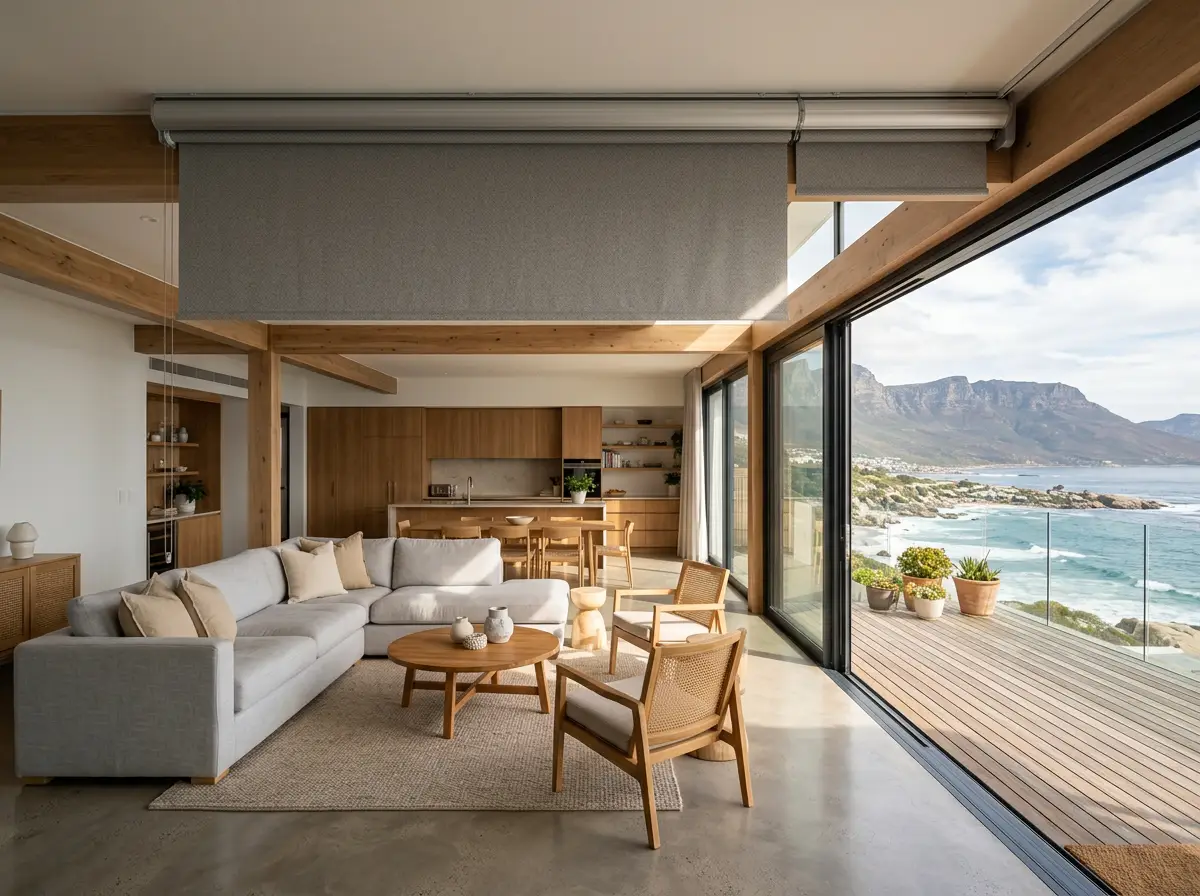
A tube, a bracket, a run of fabric. The simplest blind we make is also the one that ends up on more Camps Bay windows than everything else combined — because the fabric does the thinking.
Stand in a Camps Bay lounge at four in the afternoon and the problem introduces itself: a sheet of light off the water, straight through the glass, flat onto the television and the back of your neck. A roller blind is the least complicated answer there is. What separates a good one from a frustrating one isn’t the mechanism — it’s three choices made properly before anything is ordered.
Blockout stops light completely and adds a small insulating layer against the glass — bedrooms, nurseries, the media room. Sunscreen is the seaboard favourite: a fine mesh, rated by how open the weave is, that dims the blaze while the horizon stays readable through it. Around here we quote 3–5% openness most often; tighter kills more glare, looser keeps more view. And translucent sits between the two — a soft glow with full privacy, no view either way. One honesty note on sunscreen: its daytime privacy flips after dark, so a street-facing bedroom usually wants it paired with something opaque.
The double-bracket roller carries blockout and sunscreen on the same window — screen down through the day, blockout down at night. On an ocean-facing bedroom it beats fitting either fabric alone, and it’s tidier than stacking a curtain over a blind. Where the glass runs wide — and Camps Bay’s newer builds run very wide — a single blind carries to roughly three metres of fabric before a seam appears or the better answer becomes two linked blinds on one motor.
Chain, spring or motor. A chain is fine and familiar, and on our installs it always comes with a wall tensioner holding the loop taut — that’s the child-safety baseline, not an extra. Spring-assist suits mid-size windows you operate constantly. Motors take over as soon as the glass gets big, high or plentiful, and they delete the chain question altogether. Whatever moves the blind, the tube and brackets are powder-coated aluminium as standard on this coastline — mild steel this close to the sea is a corrosion diary waiting to be written.
A roller is quoted by the square metre, fitted, with the fabric and the control doing most of the moving. Manual — chain or spring, in blockout, sunscreen or translucent — sits between R1,000 and R1,600 the square metre. Motorised, the same window runs R2,500 to R3,800, which carries the tube motor, the remote or app channel and the commissioning on the day.
Under a certain size we stop charging by area and charge a minimum: the brackets, the tube and the hour on site are identical whether the pane is a cloakroom or a three-metre span. Read the bands as a budget, not a quote. The figure that binds is the one written per opening after the free measure.
We fit roller blinds right along this stretch of coast — sunscreen fabric for Fresnaye’s view-preserving renovations, motorised control for the tall glazing in Clifton, and salt-air rated hardware as standard on the exposed runs into Bantry Bay and Llandudno.
The measure costs nothing, the quote is written and priced window by window, and if roller isn’t right for your opening we will say so.